Digital Product Passport
Your buyer asked for a Digital Product Passport.
Put one on every unit you ship — a QR or NFC code that opens that exact item's page. Specs, documents, warranty, spare parts, recall notices.
3 products and 100 serial numbers. No card. No trial clock.
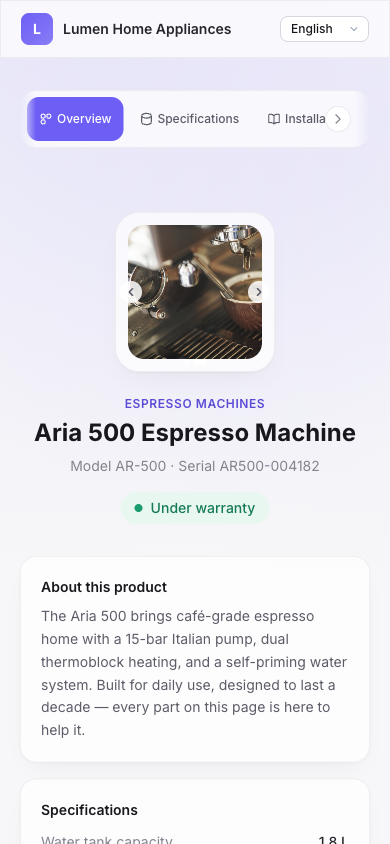
This is what your customer sees.
One scan opens the page for that individual item — not a generic model page. They get the specification, the manual, the warranty status, the error code they are looking at, and the right spare part.
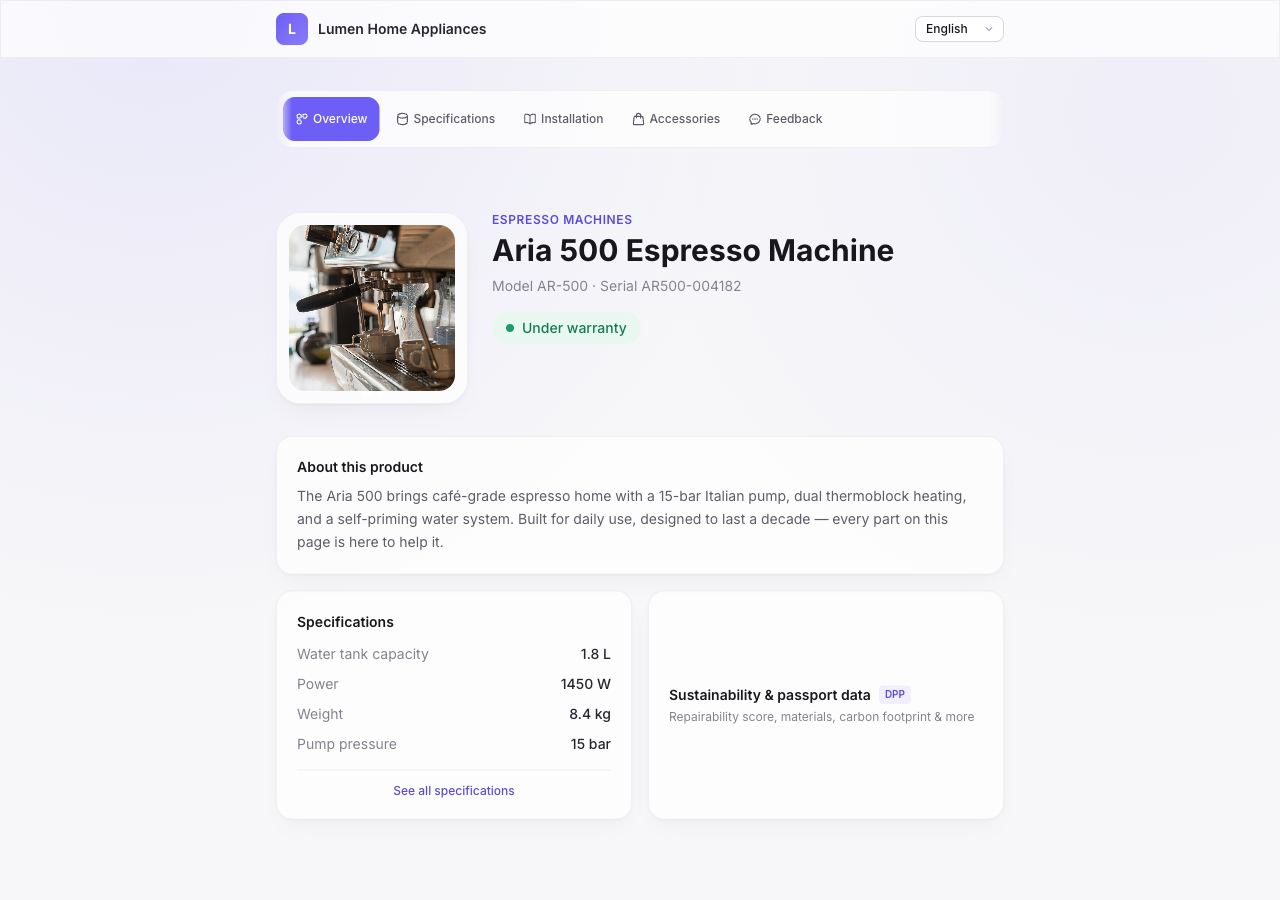
One product, one code, one page.
Every item gets its own serial number inside a GS1 Digital Link — the same standard retailers and scanners already read. It is printed on the label you already print, or written to an NFC tag.
https://id.idrune.com/lumen/01/05412345000013/21/AR500-004182
The last part is the unit. That is the whole idea.
The questions you answer twice a day, answered once.
Installation, error codes, accessories, warranty terms. Written once, in the languages of your markets, and reachable from the product itself instead of a drawer.
- Specifications and manuals
- Tank capacity, power, pump pressure — and the manual, on the product instead of in a drawer.
- Warranty by serial
- Not the model's warranty. This unit's, with its own dates, looked up by the serial on the machine.
- Error codes
- The code on the display, explained, in the language of whoever is standing in front of it.
- Spare parts and accessories
- Which part fits this one — the 2009 build and the 2019 build are different machines.
- Recall lookup
- An owner types their serial and learns whether their unit is affected. Not a press release.
- Materials and sustainability data
- Repairability score, recycled content, carbon footprint, and where each material came from — the fields a buyer's compliance officer is actually asking about. We do not assess whether they satisfy any regulation; we carry them and show them.
And this is what you work in.
One screen per product, and the rest of it is the parts of the job a passport actually creates.
- Codes for your production line
- Generate the QR or QR-plus-NFC artwork for a single unit or a whole serial range, in three card layouts, as PDF or PNG. This is the file your label supplier needs — one per unit rather than one per model.
- Scans, counted
- How many times each passport was opened, how many were distinct visitors, how many owners registered, which accessories were clicked — by day, and against the period before. You find out whether the code on the box is being used.
- Six languages, written once
- Specifications, error codes, manual sections and accessory names each carry their own translation, so the page answers in the language of the market you sold into. English, Turkish, German, French, Spanish, Italian.
- Bring a spreadsheet
- Import products, specifications and material composition from .xlsx or .csv, with column mapping and a dry run that shows you every row it would reject before anything is written.
- Colleagues, with limits
- Invite your quality manager, your after-sales lead and your marketing manager, and build roles out of twenty-four separate permissions — so the person who edits copy is not the person who can publish a recall.
- An API when you outgrow the form
- Push product and specification data, or repair and service records, straight from your ERP or PLM. You do not need it to start — twenty minutes and a form is the normal path — but it is there when a spreadsheet stops being the answer.
The code keeps working for ten years.*
We commit to resolving every passport we publish for at least ten years from the day it is published — if you stop paying us, and if you move to another vendor. The code is already printed on a product somebody owns, and we do not switch those off.
* What we commit to is permanence: this address keeps meaning this exact unit, and the pair of GTIN and serial stays reserved for it. Availability is best effort, as it is for any service on the internet — the commitment is that the meaning never moves.
And you find out who has your products.
If you sell through distributors you have probably never known who owns the thing you made. Owners who register their product become a list you can reach — for a safety notice, an update, or a recall on the exact units affected rather than a press release.
Every owner who registers is one you can reach directly — a list that grows with each unit sold.
Plans and pricing
Origin 20
€39/month+ VAT
€46.80 inc. UK VAT
Covers up to 20 published passports — one per product model you sell as a separate item.
Start with Origin 20Every paid plan includes unmetered serial numbers, all six languages, warranty and recall lookup by serial, and the ten-year resolution promise. Nothing else differs between the plans — the number of passports is the only thing you are choosing.
Billed monthly. No minimum term, cancel any time.
Prices exclude VAT, so the figure above is what the subscription costs your business. VAT is worked out at checkout from your billing country and VAT number: UK customers are charged 20% UK VAT and can reclaim it, EU businesses that enter a valid VAT number pay the price shown under the reverse charge, and customers outside the UK and EU — Türkiye included — are charged no UK VAT. Billing is in EUR; your bank sets the conversion. Seller: Build Actions Ltd, UK VAT-registered.
Archiving a passport costs €5, once — and hands its slot back so you can publish another. The archived passport goes read-only but keeps resolving, so every code already printed on a unit you sold still works for its full ten years. Archiving the same product again later is free.
If none of these fits your catalogue, write to us with your numbers and we will send back a price. [email protected]
Put a passport on your next batch.
No card. Three products, a hundred serial numbers, no time limit.